

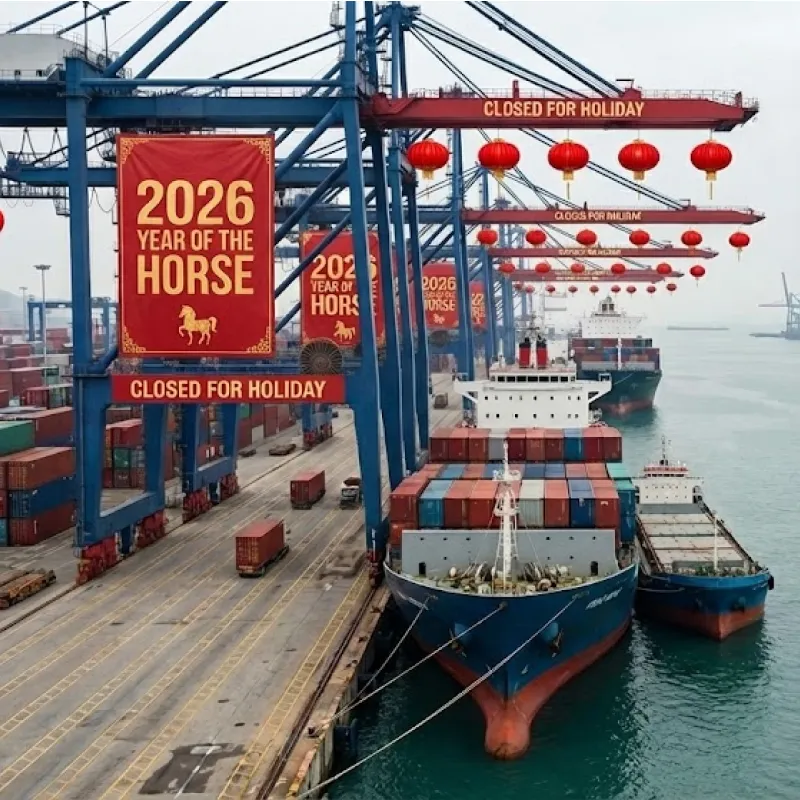
Doing business with Asia in the first quarter of 2026?
Then planning ahead is crucial.
Q1 includes several important Asian holidays that directly impact production, availability, transit times, and communication. By recognizing these moments in time, you can prevent delays and maintain control over your supply chain.
Below you will find an overview of the most important Asian holidays in Q1 2026, including exact dates and, above all: what this specifically means for your logistics planning.
January 2026: regional closures and limited accessibility
January 1 (Thu) – New Year’s Day
Official holiday in, among others, China, Japan, Singapore, Hong Kong and South Korea.
Impact on logistics
- Limited office occupancy
- Slower communication with partners and authorities
- Generally limited disruption, but relevant for planning
January 13 (Tue) – Lohri (India, Punjab region)
Culturally important winter and harvest festival.
Impact on logistics
- No national closure
- Local businesses may have limited accessibility
January 14 (Wed) – Makar Sankranti / Pongal (India)
- Makar Sankranti: celebrated in multiple Indian states
- Pongal: major festival in Tamil Nadu (often several days)
Impact on logistics
- Regional closures of companies and government agencies
- Delay in local handling and documentation
February 2026: the most critical month
February 17 (Tue) – Chinese New Year (Lunar New Year)
This is by far the most important holiday period in Q1 2026.
Celebrated in, among others:
- China
- Hong Kong
- Taiwan
- Singapore
- Malaysia
- Vietnam (Tet)
- South Korea (Seollal)
Impact on logistics
- Production in China is often largely at a standstill 1–2 weeks before and after the holidays
- Factories close, staff travels
- Capacity pressure and congestion prior to the holidays
- Slower restart afterwards
Early booking and realistic planning are essential here.
February 16–18 (Mon–Wed) – Tet (Vietnam)
Vietnam’s most important holiday period, comparable to Christmas and New Year’s Eve together.
Impact on logistics
- Production and export are largely at a standstill
- Very limited availability of local partners
- Gradual restart afterwards
February 17–19 (Tue–Thu) – Seollal (South Korea)
Korean New Year.
Impact on logistics
- Official holidays
- Limited domestic transport capacity
- Slower administrative processes
February 19 (Thu) – Lantern Festival (China)
Traditional closing of the Lunar New Year period.
Impact on logistics
- Culturally important
- Operations are resumed, but backlogs may still be present
March 2026: locally significant, logistically relevant
March 3 (Tue) – Hinamatsuri (Japan)
Cultural holiday, not an official holiday.
Impact on logistics
- Limited operational impact
March 4 (Wed) – Maha Shivaratri (India & Nepal)
Impact on logistics
- Regional closures
- Possible delays at government agencies
March 25 (Wed) – Holi (India & Nepal)
The famous festival of colors.
Impact on logistics
- Major national disruption in India
- Many companies and governments closed
- Transport and customs clearance delayed
Q1 2026: what to remember
The following three moments:
- February 17 – Chinese New Year
→ Greatest impact on production, capacity and lead times. - February 16–19 – Tet & Seollal
→ Multiple Asian markets delayed simultaneously. - March 25 – Holi (India)
→ National impact in an important sourcing market.
Plan ahead with Van der Helm Logistics
Successfully doing business with Asia is not just about data, but about thinking ahead, reserving capacity and realistic expectations.
Van der Helm Logistics supports you with:
- Proactive planning around peak periods and holidays
- End-to-end forwarding, warehousing and customs solutions
- Clear communication with Asian and European partners
- Insight into lead times and potential risks
Active in Asia in Q1 2026?
Make sure your supply chain is prepared — before the holidays begin.
Contact our team to coordinate your planning and capacity in a timely manner.