

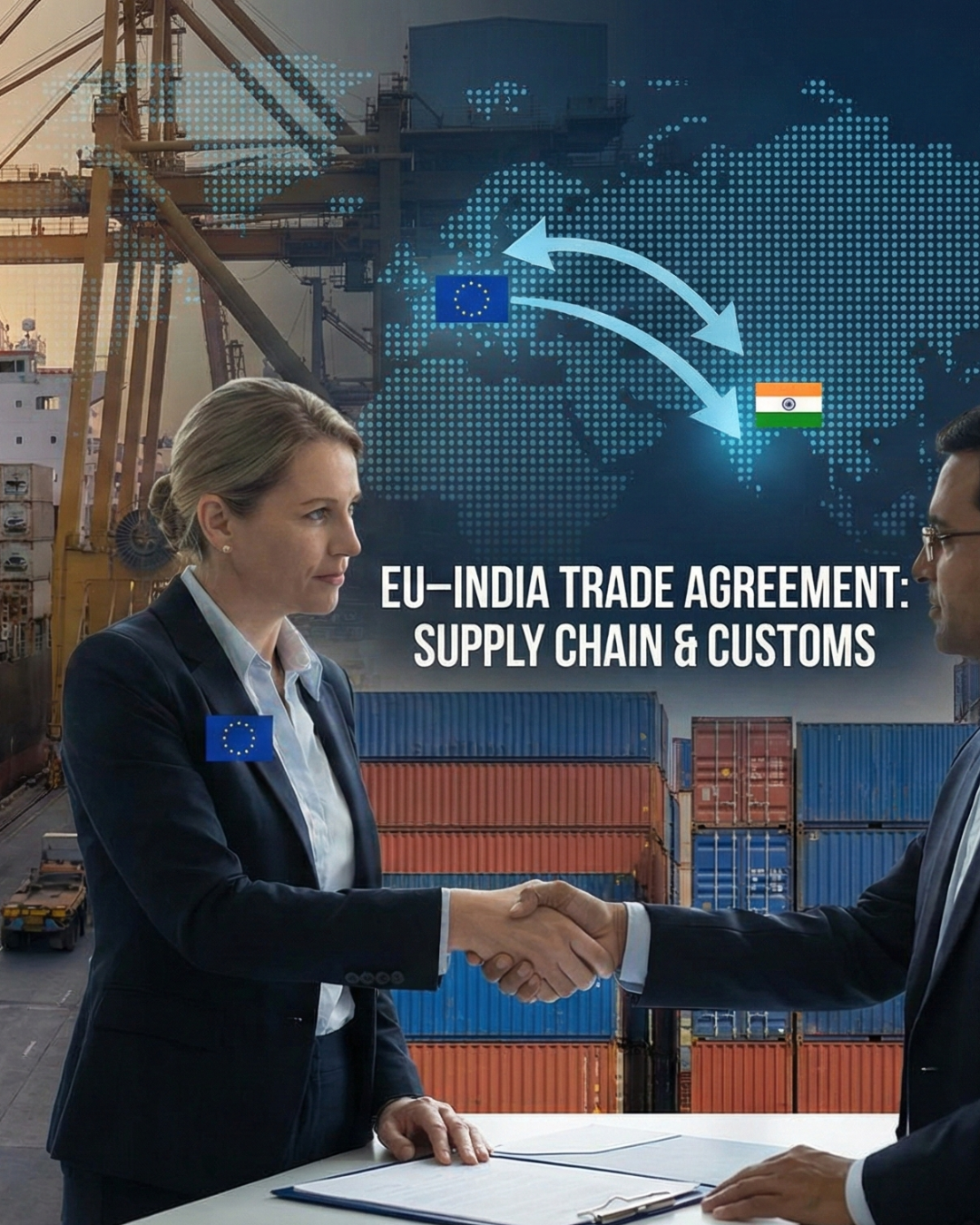
After nearly twenty years of negotiations, the European Union and India have finalized a Free Trade Agreement (FTA). Once formally approved and ratified, this agreement will lead to a significant reduction – and in many cases, the complete elimination – of import duties between both economies.
It is the largest trade agreement ever concluded by both the EU and India. But more important than its size is what this agreement says about the direction in which international trade is moving.
What does the EU–India Trade Agreement entail?
According to the European Commission, import duties will be phased out on:
- 96.6% of goods exported from the EU to India
- 99.5% of goods exported from India to the EU, phased over a period of seven years
This will make it structurally more attractive for European companies to trade with India. At the same time, Indian producers will gain broader access to the European market, including for products such as textiles, leather goods, chemicals, rubber, base metals, and jewelry.
It is expected that European exports to India will double by 2032 as a result, and that European companies will collectively save billions of euros in import duties.
Why this trade agreement is more than just a tariff reduction
Although this agreement is often presented as an economic deal, it is primarily a strategic choice. The EU has been working for some time to reduce its dependence on traditional trade blocs and diversify its trade relationships.
India fits this picture as:
- a rapidly growing market
- an alternative production location
- a geopolitically stable partner within an increasingly complex global playing field
For many companies, this means that India is shifting from “interesting” to “seriously worth considering.”
Consequences for international supply chains and sourcing strategies
Lowered or abolished import duties enable new business cases but also lead to existing supply chains being re-evaluated.
We are already seeing companies:
- including India in sourcing and production strategies
- considering dual sourcing (e.g., alongside China or Southeast Asia)
- wanting to spread volumes to better manage risks
This has direct consequences for transport flows, routing, inventory positions, and the setup of European distribution centers.
Free trade does not mean less customs complexity
A common misconception is that free trade automatically means less customs work. In practice, the opposite is often true.
To benefit from preferential tariffs, the following apply:
- strict rules of origin
- documentation and proof requirements
- correct HS classification and valuation
Especially with complex supply chains, where components come from multiple countries, proving origin can be challenging. Errors or ambiguities quickly lead to corrections, additional assessments, or delays.
Thus, the trade agreement lowers financial thresholds but simultaneously places higher demands on compliance and preparation.
This agreement in the broader European trade context
The timing of this agreement is striking. At the same time, we are seeing:
- the introduction of CBAM, which imposes additional administrative obligations on the import of certain goods
- increasing attention to transparency, sustainability, and origin
- stricter controls on e-commerce and low-value import flows
Together, these developments ensure that companies not only want to purchase more cheaply but also need better insight into their supply chain.
What does this concretely mean for European importers?
For European importers, the EU–India Trade Agreement brings both opportunities and new responsibilities. Lowered or abolished import duties make new trade flows attractive, but only when the conditions are met.
In practice, this means importers must ask themselves, among other things:
- Do our products demonstrably meet the rules of origin to qualify for preferential tariffs?
- Are HS classifications and customs valuations correct and future-proof?
- How do we ensure that documentation holds up during checks or audits?
- What is the impact on existing supplier structures and contracts?
Particularly in complex supply chains, where raw materials or semi-finished products originate from multiple countries, proving origin can be challenging. Without proper substantiation, tariff benefits are lost, and corrections or delays can occur.
For many importers, this agreement is therefore a logical moment to reassess their customs and supply chain setup. Not out of urgency, but from a position of control.
Why this is the right time to re-evaluate supply chains
This trade agreement will not change everything overnight. Precisely for this reason, it is a good time to:
- re-evaluate supply chain structures
- assess whether current customs processes are future-proof
- gain insight into potential opportunities and risks
Companies that wait until regulations are fully implemented often fall behind. Companies that calculate scenarios now maintain control.
Looking ahead instead of adjusting afterward
The EU–India Trade Agreement is not an isolated news item but part of a broader movement in international trade: less dependence, more diversification, and higher demands on compliance.
At Van der Helm, we closely monitor these developments, not based on daily whims, but from the question: what will this concretely mean for goods flows, customs processes, and business operations?
Those who think about this now are better prepared for what is to come.
Van der Helm Logistics has been supporting companies with customs and logistics issues within international supply chains for decades.