

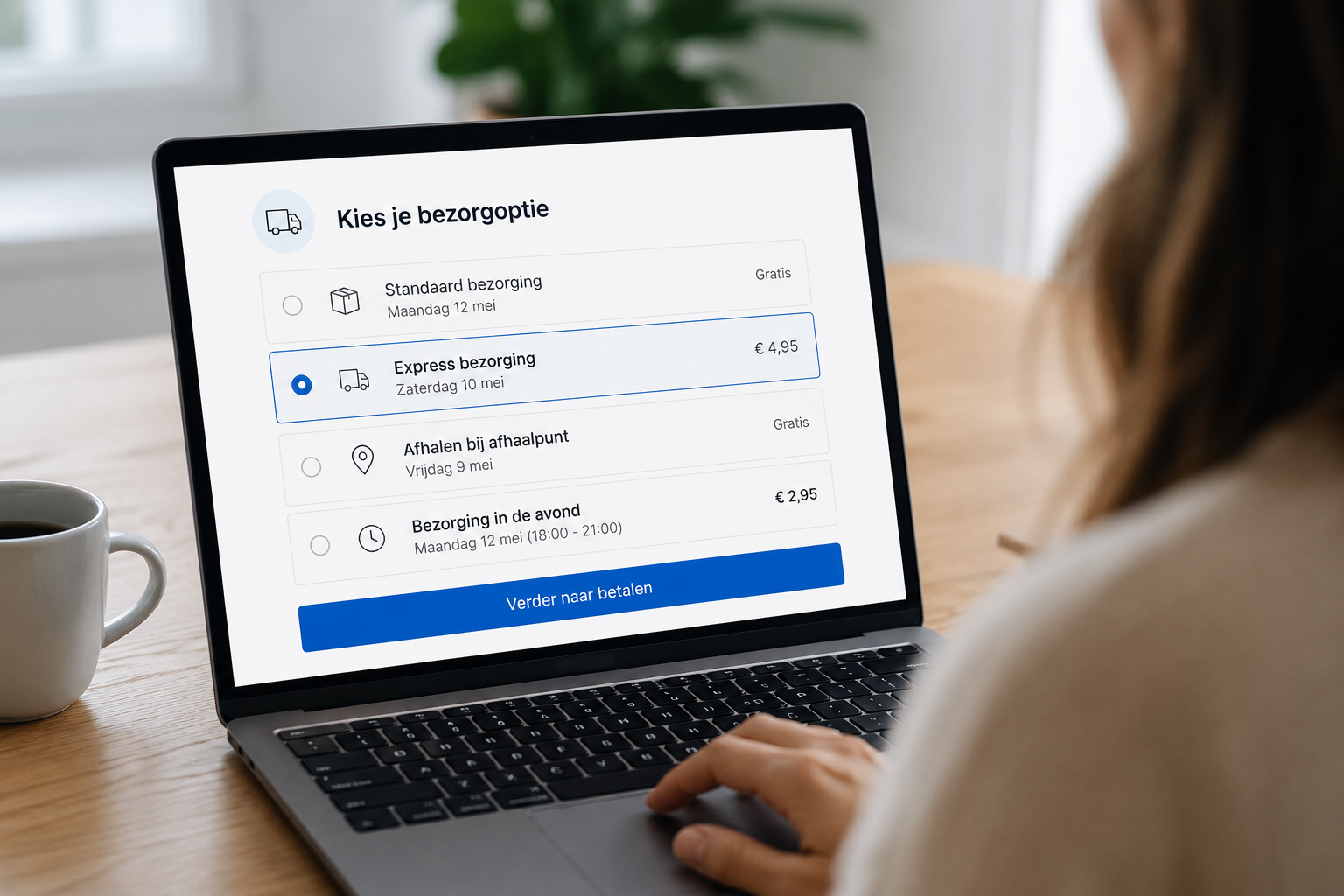
For many webshops, the focus lies on marketing, product range, and price. Yet, one of the most important conversion factors is often underestimated: the delivery options during checkout.
It is precisely in the final step of the purchasing process that consumers decide whether they will actually place an order. When the delivery options offered do not meet their needs, the likelihood of a shopping cart being abandoned increases.
That is not only a missed sale, but also a missed opportunity to build brand loyalty with a new customer.
The checkout is a crucial moment in the customer journey
Consumers have become accustomed to flexibility. They increasingly decide for themselves where, when, and how an order is delivered. Therefore, a standard shipping option no longer always meets expectations.
Research shows that as many as 76 percent of consumers hesitate about a purchase when only one shipping method is available. This means that the way you present delivery options directly affects your conversion rate.
For webshops that sell internationally, this becomes even more important. Delivery preferences vary significantly by country, target group, and product category. What works well in the Netherlands is not automatically successful in Germany, Scandinavia, or Belgium.
A flexible logistics strategy helps to better align with local expectations and increases the chance of a successful order.
Consumers expect freedom of choice
While consumers used to look primarily at the price of shipping, several factors play a role today.
Think, for example, of:
- Delivery on a specific day
- Evening delivery
- Express shipping
- Pick up at a parcel point
- Delivery to a parcel locker
- Sustainable delivery options
For one customer, speed is central. For another, convenience is more important. By offering different options, you give consumers the opportunity to make the best choice for themselves.
This not only leads to more orders but also to a better customer experience.
Less uncertainty creates more trust
A common reason for drop-offs during checkout is uncertainty.
When a customer does not know exactly when an order will be delivered, doubt arises. Especially with products that are needed quickly or if a delivery is part of a schedule.
That is why more and more webshops are choosing to show concrete delivery times. Not just an indication like “within 2 to 4 business days,” but an exact delivery day or even a specific time slot.
Transparency builds trust. And trust often leads to a higher conversion rate.
For logistics processes, this means that inventory management, fulfilment, and carriers must be seamlessly aligned. Only then can delivery times be displayed reliably.
The role of fulfilment is growing
Many webshops see delivery options as a marketing issue. In reality, this starts much earlier in the supply chain.
To offer consumers multiple delivery choices, the logistics operation must be fully set up for it. Think of:
- Real-time inventory management
- Smart carrier selection
- Fast order processing
- Integrations with carriers
- International distribution networks
When these processes are properly organized, the flexibility arises to offer customers various delivery options without compromising efficiency or cost control.
At Van der Helm, we see that successful e-commerce organizations are increasingly investing in scalable fulfilment solutions. Not just to process more orders, but specifically to offer customers more freedom of choice during checkout.
Pick-up points are gaining ground
A development we see more and more often is the growth of pick-up points and parcel lockers.
For consumers, these solutions offer flexibility. They do not have to stay home for a delivery and can pick up a package when it suits them.
For webshops, this often provides additional benefits:
- Fewer failed delivery attempts
- Lower transport costs
- Higher customer satisfaction
- More delivery capacity during peak periods
Particularly in international e-commerce markets, the use of pick-up and drop-off locations is growing rapidly. In several European countries, this delivery method is now part of standard consumer expectations.
Data helps to make the right choices
Offering multiple delivery options is not a one-time decision. Consumer behavior is constantly changing.
That is why data is becoming increasingly important within e-commerce logistics. By analyzing which delivery methods are chosen most often, which options lead to higher conversions, and where customers drop off, webshops can continue to optimize their checkout.
Even small adjustments can make a big difference.
Think, for example, of:
- Displaying popular delivery options more prominently
- Adding express delivery
- Highlighting the fastest shipping method
- Offering local delivery preferences per country
By continuously testing and improving, a checkout is created that better aligns with customer expectations.
Logistics as a growth accelerator for e-commerce
The checkout may seem like just the last step of an order, but it often makes the difference between a sale or an abandoned cart.
Today’s consumers expect flexibility, clarity, and freedom of choice. Webshops that respond to this not only create a better customer experience but also often increase their conversion rate.
This requires more than just adding extra shipping options. It requires a logistics operation that is scalable, reliable, and flexible enough to deliver on that promise.
At Van der Helm, we help e-commerce companies with fulfilment, inventory management, and international distribution that meet the expectations of modern consumers. This creates a logistics solution that not only works efficiently but also contributes to growth, customer satisfaction, and higher conversions.