

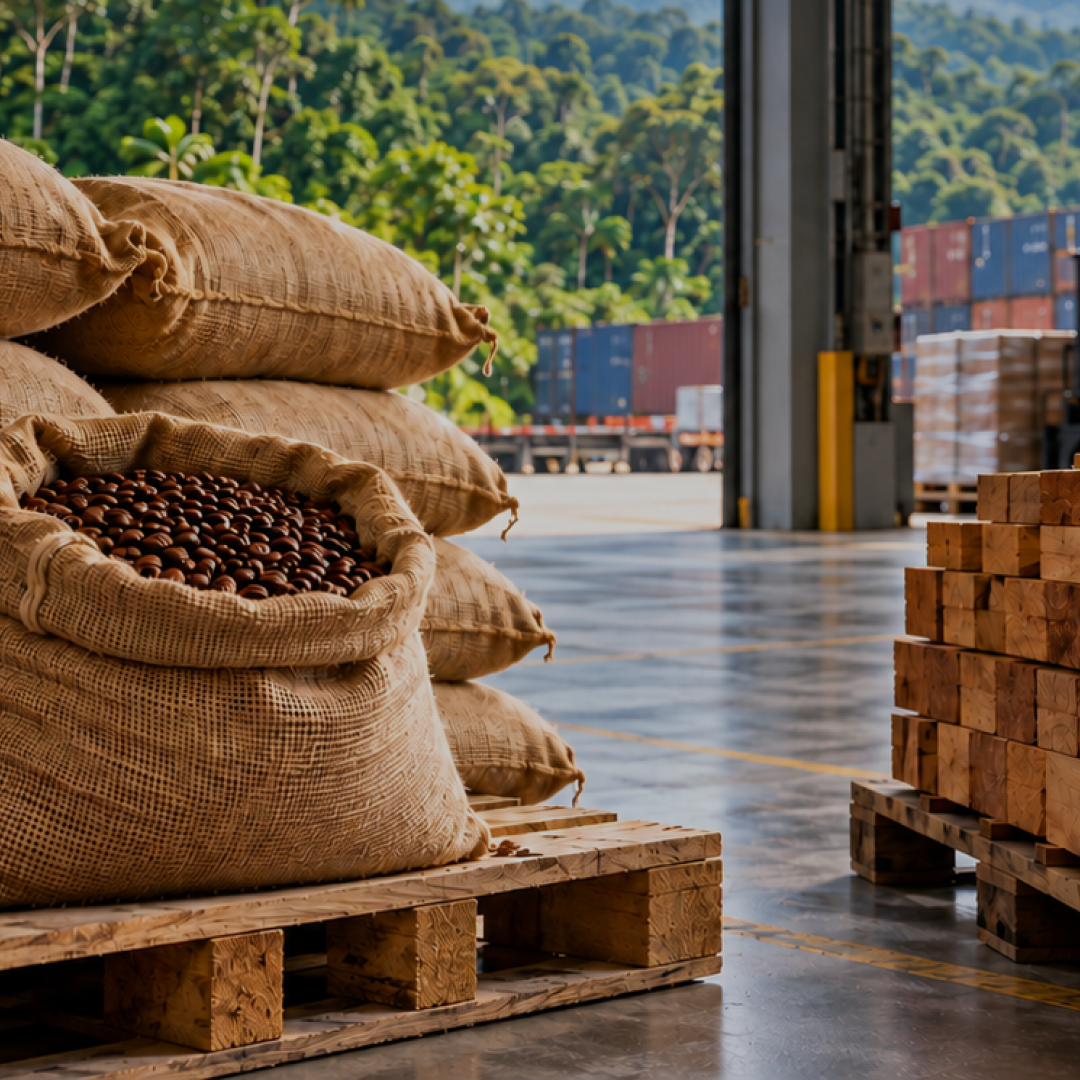
The European Union Deforestation Regulation is approaching
From December 30, 2026, the European Union Deforestation Regulation (EUDR) will become applicable. This regulation can have significant consequences for your import and export processes.
Do you produce, import, or export products that fall under the EUDR? Then you must be able to demonstrate that these products:
- are deforestation-free;
- have been produced legally;
- are fully traceable to the production site.
The NVWA advises companies to start preparing. Therefore, do not wait until the end of the year, but check in a timely manner whether your products, suppliers, and supply chain are ready for the new obligations.
What is the EUDR?
The goal of the EUDR is to ensure that certain commodities and products placed on the European market or exported from the EU are deforestation-free and legally produced.
The EUDR applies to the following commodities:
- Cattle
- Cocoa
- Coffee
- Oil palm
- Rubber
- Soy
- Wood
In addition, various derived products also fall within the regulation, such as certain chocolate products, leather goods, tires, furniture, and paper products.
Whether a product falls under the EUDR is determined based on the products listed in Annex I of the EUDR.
Correct product classification is essential
Whether a product actually falls under the EUDR depends not only on the HS/CN code but also on the specific description included with the code in Annex I.
Several commodity codes include the designation ‘ex’. This means that not all goods within that code automatically fall under the EUDR, but only those products that meet the specific description.
An incorrect classification can therefore lead to a wrong assessment of your EUDR obligations.
Are you unsure about the classification of your products? Our customs specialists can support you with this.
What does the EUDR mean for your organization?
When you place products under the EUDR on the European market or export them, you must apply a due diligence system.
This consists of four steps:
1. Collect information
Collect information about the product, its origin, and the supply chain.
2. Assess risks
Assess whether there is a risk that the product does not comply with the EUDR.
3. Mitigate risks
Are there risks? Then appropriate measures must be taken to reduce them to a negligible level.
4. Record due diligence documentation
The due diligence documentation must be recorded and kept for at least five years.
What information do you need?
This includes, among other things:
- product description;
- HS/CN code;
- quantity and net weight;
- country of production;
- production period;
- geolocation of the relevant plots of land;
- supplier and customer details;
- traceability information;
- proof of deforestation-free production;
- proof of compliance with local legislation.
It is therefore important to start discussions with suppliers now and determine whether they can provide this information in a timely manner.
The Due Diligence Statement (DDS)
Once the required due diligence has been carried out, a Due Diligence Statement (DDS) must be submitted to the European EUDR Information System (TRACES).
After submission, you will receive a DDS reference number.
For imports, this reference number must be available before the import declaration is submitted, as the number must be stated in the customs declaration.
Our advice: do not wait until your goods arrive. Ensure that the necessary information is available well before the arrival of the goods.
Are important data or supporting documents missing? Then the DDS may not be submitted in time. This can have direct consequences for your customs process.
If the required information cannot be obtained, the product may not be placed on the EU market or exported from the EU according to the EUDR.
Your responsibility
The responsibility for compliance with the EUDR always remains with the operator or trader responsible for the goods in question.
This means that your organization remains responsible for:
- the accuracy and completeness of the information;
- the traceability of products;
- demonstrating deforestation-free production;
- compliance with relevant legislation in the country of production;
- the execution and substantiation of due diligence.
The NVWA can carry out checks on importers, exporters, producers, and traders. The relevant documentation must be kept for at least five years.
Van der Helm as EUDR Authorized Representative
Do you want support in submitting the DDS?
Van der Helm Customs Services can act as an EUDR Authorized Representative and submit the DDS to the EUDR Information System (TRACES) on behalf of your organization.
The EUDR makes it possible to appoint an authorized representative for submitting the DDS. However, your organization remains responsible for compliance with the EUDR.
When Van der Helm provides this service, we receive all necessary product, production, chain, and geolocation data from your organization in a timely manner.
Additional contractual agreements are made in advance for this service.
What can you do now?
- Check which products may fall under the EUDR.
- Check if your HS/CN codes are correct.
- Map out your supply chain.
- Discuss with suppliers what data they can provide.
- Set up your due diligence process.
- Determine whether you will submit the DDS yourself or want to use Van der Helm as an EUDR Authorized Representative.
Prepare in time
The EUDR requires more than just submitting a statement. Correct product classification, reliable supplier information, traceability, and a well-established due diligence process are essential to be compliant.
Do you have questions about the EUDR, are you unsure if your products fall under the regulation, or do you want to know how Van der Helm can support you?
Then contact your regular contact person or one of our Customs Specialists.