

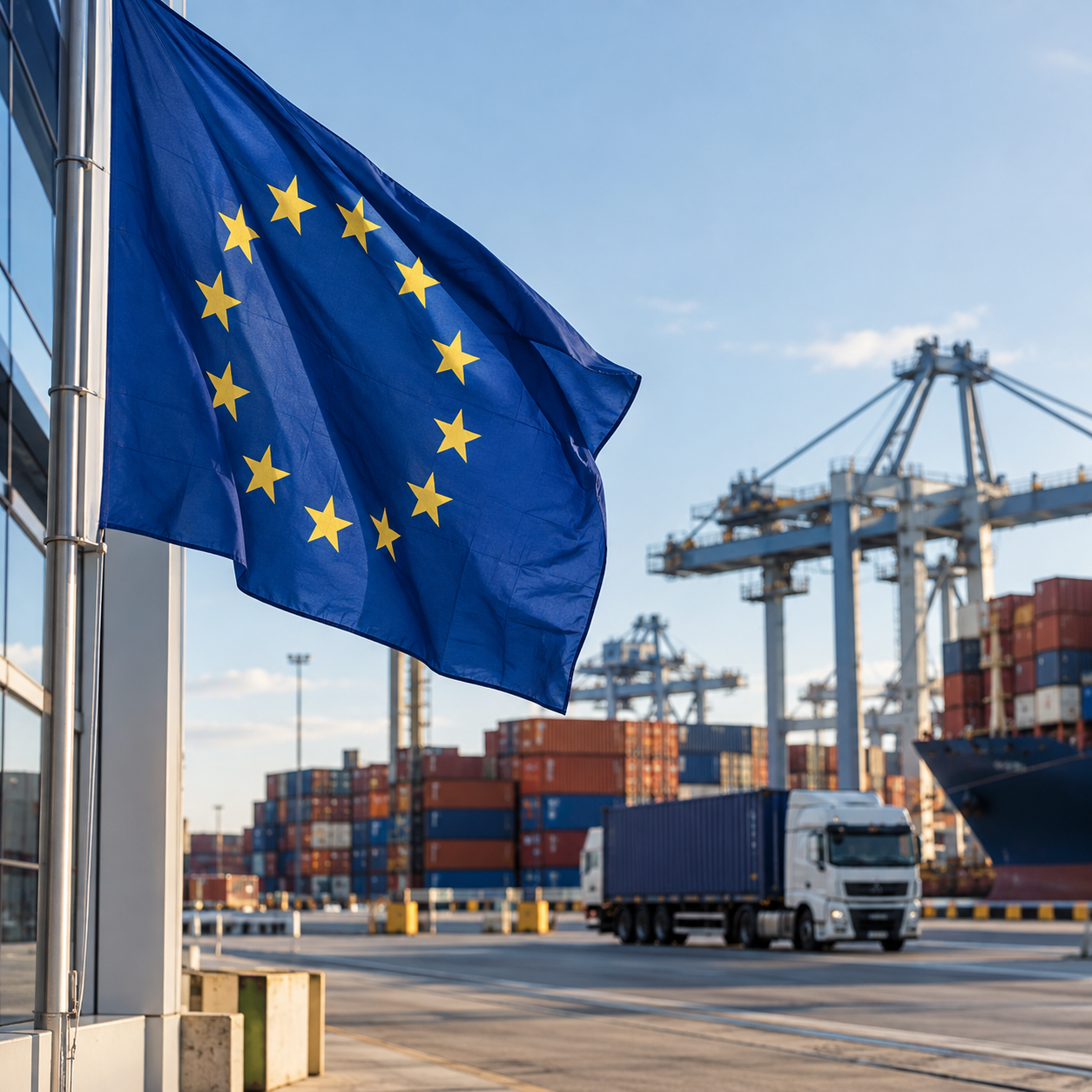
European customs legislation is on the verge of a major transformation. With the new Union Customs Code (nUCC), the European customs system will be reformed step-by-step over the coming years. The core of this change: customs supervision is increasingly shifting from individual declarations to reliable, up-to-date, and structured data regarding products, trade flows, and supply chains.
According to the Dutch Customs, this is the largest reform of the European customs system since the establishment of the Customs Union in 1968. The reform introduces, among other things, a European Customs Data Hub, a new EU Customs Authority, and new opportunities for trusted traders. Implementation will take place in phases and will continue until 2034.
For importers and other companies engaged in international trade, this means that data quality is becoming an increasingly important factor within the customs process. It is therefore wise not to wait until all components of the nUCC become mandatory, but to start looking now at the quality and availability of product, supplier, and customs data within your organization.
From declaration-driven to data-driven customs supervision
Today, a large part of the customs process still revolves around individual declarations. For every movement of goods, information is collected, submitted, and processed within various national customs systems.
The nUCC fundamentally changes that model.
Central to the future system is the EU Customs Data Hub: a single European digital environment where companies can submit customs and product information. The goal is that information eventually does not have to be resubmitted for every individual shipment and that customs authorities in the various EU member states can work with the same data.
Furthermore, the Data Hub should give European customs authorities access to more up-to-date and better-integrated information on trade flows and supply chains. This allows risk management to take place increasingly at the European level and enables authorities to determine more specifically which goods or trade flows require extra attention.
For your organization, this simultaneously means that the quality of the underlying data becomes more important. A correct commodity code remains necessary, but it is increasingly becoming just one part of a broader set of information about the product, the parties involved, and the supply chain.
The importer’s responsibility becomes more significant
Another important development within the new customs system is the position of the importer.
Upon import, it must be clear which party is responsible for the goods. Under the new system, that responsibility explicitly covers both fiscal and non-fiscal obligations. Non-fiscal requirements include, for example, European rules regarding product safety and other product-related legislation.
This does not mean that the same information is required for every product. Which data and documents are relevant depends on the product, its origin, your trade structure, and the applicable legislation.
In practice, we therefore expect that you will need to have increasingly better insight into data such as product descriptions, HS classifications, origin, manufacturers and suppliers, and relevant product documentation. Depending on the product, data regarding CE marking, batteries, product safety, or other market surveillance requirements may also be important.
As a result, product data is increasingly becoming more than just a topic for the customs department. Information from procurement, product management, compliance, IT, and supply chain management may also be necessary to move your goods efficiently through the customs process.
The EU Customs Data Hub will be introduced in phases
The transition to the new system will not happen all at once.
For e-commerce, a significant part of the change will take place first. According to the current planning, the EU Customs Data Hub will be mandatory for e-commerce from July 1, 2028.
From March 1, 2031, the Data Hub will be opened for voluntary use by other companies. Subsequently, its use will become mandatory from March 1, 2034, for all traders covered by the new system.
The years leading up to 2034 are therefore not a period in which you need to do nothing. The technical infrastructure, European implementation rules, national legislation, and business processes are being adapted step-by-step.
Does your organization have large import volumes or complex international supply chains? Then it is wise to assess well before the final deadlines whether the necessary data within your organization is available, reliable, and structured.
Changes have already begun for e-commerce
Do you sell goods from countries outside the EU directly to consumers within the European Union? Then parts of the reform are already concretely relevant now.
Since July 1, 2026, a temporary import tariff of €3 per item has applied to certain e-commerce goods as a result of the amendment to the previous exemption from import duties. Additionally, from November 1, 2026, product identification will be mandatory in the import declaration for e-commerce.
Product identification goes further than a general product description. It concerns a unique code with which a specific model, a specific batch, or a specific product can be recognized and tracked. According to Customs, this identification can be assigned by, among others, the manufacturer, producer, supplier, online seller, marketplace, or the online platform.
In addition, a European handling fee for e-commerce is planned. At the time of publication, the Dutch Customs expects implementation around November 1, 2026, but the exact amount of this fee is not yet definitively known.
For e-commerce companies, these developments make it clear how quickly the role of product data is changing. Information that you previously used primarily in your webshop, ERP system, or supplier documentation can increasingly become directly relevant to the customs process.
More data also means more attention to data quality
The development towards a single European Data Hub offers advantages. Ultimately, you should be able to submit information once and reuse data for multiple movements of goods. This should reduce administrative burdens and make processes more efficient.
But there is an important condition attached: the data provided must be correct and reliable.
Is information about, for example, classification, origin, suppliers, or product characteristics scattered across different systems or maintained manually? Then it may become more difficult to consistently provide the same correct data.
Our expectation is therefore that data quality will have an increasingly direct influence on the efficiency of your customs processes. Incomplete, inconsistent, or difficult-to-trace data may more readily lead to additional questions or inspections and thus potentially lead to delays.
Preparing for the nUCC is therefore not exclusively a customs project. It also affects the organization and quality of the underlying business data within your organization.
Trust & Check: more trust with more transparency
The new customs system also introduces a new category for highly reliable and transparent traders: Trust & Check traders.
If your organization meets the future conditions and can provide extensive, reliable information about movements of goods and compliance, it may be able to utilize further simplifications within the customs process. The precise conditions and implementation are being further developed.
The principle behind Trust & Check clearly shows the direction in which European customs processes are developing: if you have a demonstrable grip on your supply chain, compliance, and data, you may be able to use simplified processes more easily in the future.
Reliable data thus becomes not only a compliance requirement but can also become an operational advantage.
What does this mean for your organization?
You do not need to completely redesign your entire customs process today. However, this is a logical moment to investigate how well your organization is prepared for an increasingly data-driven customs environment.
An important starting point is the question of where your essential product and trade information is located.
For example, is the HS classification centrally recorded and structurally checked? Is the origin of goods demonstrable? Are manufacturer and supplier data available? Is it clear which entity within your trade structure acts as the importer? And can relevant product documents be easily linked to specific items?
Do you have a large assortment, multiple suppliers, different ERP systems, or a complex international trade structure? Then there is a greater chance that important information is scattered across different departments and systems.
By mapping out that situation now, you create time to improve processes in a controlled manner instead of only reacting when new requirements become mandatory.
What will Van der Helm Logistics do in the coming period?
Van der Helm Logistics is closely following the further development and implementation of the nUCC, the EU Customs Data Hub, and the changes surrounding e-commerce.
Where this is relevant to our services, we will gradually update existing customer files and collect additional information. This may include, for example, supplier information, the role of the importer, product documentation, and classification and origin data.
When additional data becomes necessary for your specific trade flows, we will contact you directly about this.
In doing so, we want to prevent you from having to provide unnecessarily large amounts of information. Instead, we focus on the data that is relevant to your specific trade flows and customs processes.
From regulation to a workable logistics and customs process
New customs legislation can be complex. Especially with a reform that is being implemented over several years and where customs rules, product legislation, IT systems, and supply chain data are becoming increasingly interconnected.
The role of Van der Helm Logistics is therefore not only to follow new regulations but primarily to translate them into your daily practice.
As a logistics partner, we support you with issues regarding international trade flows, import structures, customs and product data, compliance, e-commerce, and preparation for future European customs requirements.
Because logistics, customs, warehousing, transport, and digital processes converge within Van der Helm, we can look beyond just the declaration. It is precisely the connection between data, customs formalities, and the physical flow of goods that will become increasingly important in the coming years.
Our goal remains the same: to ensure that your international flow of goods can continue to run as smoothly, efficiently, and compliantly as possible, even in a changing customs landscape.
Preparing for the nUCC?
The full transition to the new European customs system will take several more years. At the same time, the first changes for e-commerce show that the transition has already begun.
This is therefore the right time to gain insight into the quality of your product data, import structures, and customs processes.
Do you want to know which parts of the nUCC may be relevant to your organization? Or would you like to have your current situation assessed? Then contact your contact person at Van der Helm Logistics.
We are happy to help you translate the new requirements into practical preparation for your organization.
More information
Want to know more about the new Union Customs Code? View the latest information on the website of the Dutch Customs:
https://www.douane.nl/kennisbank/handboeken/handboek-douane-en-wetteksten-dwu/ndwu/